
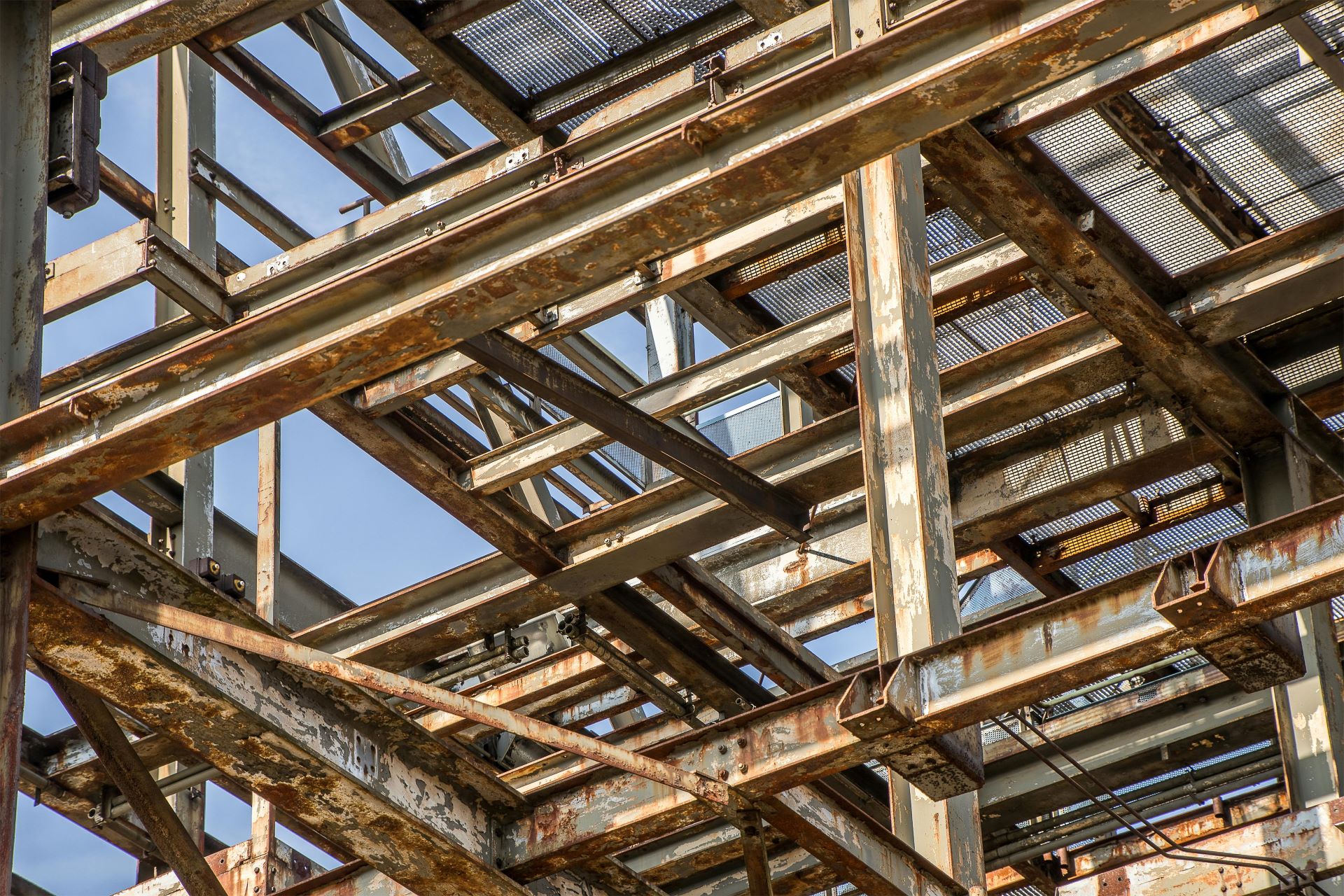
Structural Steel Corrosion in South Africa’s Industrial Buildings
Understanding Structural Steel Corrosion in South Africa
In South Africa’s industrial landscape, steel is everywhere. It holds up warehouses in Durban’s humid coastal belt, frames manufacturing plants in Gauteng’s high-traffic industrial zones, and reinforces logistics hubs stretching across inland corridors. Yet beneath this strength lies a slow, quiet process that rarely announces itself until damage is already advanced.
Structural steel corrosion is not a sudden failure. It is a gradual transformation of metal back into its natural oxide state. In industrial buildings, this process is often hidden within cladding systems, behind fireproofing layers, or embedded within reinforced concrete elements. By the time rust becomes visible, the structural compromise may already be well underway.
South Africa presents a particularly complex environment for steel longevity. Coastal humidity, inland pollution, salt-laden air in port cities, and seasonal temperature shifts all contribute to accelerated corrosion cycles. Durban, Cape Town, and Port Elizabeth face persistent moisture exposure, while inland industrial hubs contend with airborne contaminants and chemical pollutants that react aggressively with protective coatings.
What makes corrosion especially challenging in industrial buildings is its invisibility during early stages. It begins microscopically, often at coating imperfections or joints, then spreads beneath the surface like a slow-moving network. This is why inspection and coating systems are not optional maintenance tasks but essential structural preservation strategies.
The Environmental Reality of Corrosion in South Africa
To understand corrosion in South African industrial buildings, it is necessary to examine the environmental drivers that accelerate it. Steel does not degrade uniformly; it responds to moisture, oxygen, and chemical exposure in highly specific ways.
Coastal regions introduce chloride-rich air. These chlorides penetrate protective coatings and trigger pitting corrosion, a particularly aggressive form that creates small but deep cavities in steel surfaces. Once pitting begins, it becomes self-sustaining and difficult to reverse.
Inland industrial zones face a different challenge. Here, sulfur compounds from industrial emissions combine with moisture to form acidic conditions on steel surfaces. Over time, this leads to uniform corrosion, thinning structural elements gradually rather than attacking them in concentrated spots.
Humidity is a constant factor across much of the country. Even in drier regions, condensation cycles within buildings can create micro-environments where moisture accumulates. Roof spaces, poorly ventilated service areas, and enclosed steel frameworks often become hidden corrosion zones.
Temperature fluctuations further complicate the issue. Expansion and contraction cycles cause micro-cracks in coatings, allowing moisture ingress. Once water reaches bare steel, corrosion begins almost immediately.
In industrial buildings, these environmental factors rarely act alone. Instead, they combine into layered corrosion pressures that require equally layered protection strategies.
How Corrosion Develops Beneath the Surface
Rust is often imagined as a visible, flaky layer spreading across exposed metal. In reality, structural steel corrosion typically begins beneath protective coatings.
The process starts when oxygen and moisture breach a coating system through microscopic defects. These defects may be caused by mechanical damage during installation, ageing of protective layers, or improper surface preparation before painting.
Once moisture reaches the steel substrate, an electrochemical reaction begins. Iron atoms lose electrons and combine with oxygen to form iron oxide. This reaction expands the material’s volume, creating internal stress beneath coatings. As the corrosion product grows, it lifts and separates the protective layer, exposing more steel.
This creates a feedback loop. More exposure leads to more corrosion, which leads to further coating failure. The process accelerates over time, particularly in humid environments where moisture is continuously available.
In industrial buildings, this cycle is often hidden within structural joints, bolt connections, and load-bearing columns. These are areas where inspection is most difficult, yet most critical.
Corrosion does not simply weaken steel by removing material. It also alters load distribution, introduces stress concentration points, and compromises the designed safety margins of the structure.
Key Risk Zones in Industrial Buildings
Not all structural steel in an industrial building corrodes at the same rate. Certain areas are significantly more vulnerable due to exposure, design complexity, or maintenance limitations.
Roof structures are among the most at-risk components. They are exposed to direct rainfall, condensation, and temperature variation. In many South African industrial facilities, roof trusses are enclosed and rarely inspected after installation, allowing corrosion to progress unnoticed for years.
Base plates and foundation connections also present high risk. These areas often trap moisture, especially where drainage is poor or concrete has cracked. Once corrosion begins at the base, it can compromise entire vertical load paths.
Joints and welds are another critical zone. Welding alters the microstructure of steel, making it more susceptible to corrosion if not properly treated. Bolted connections can also trap moisture between overlapping surfaces, creating hidden corrosion pockets.
Internal service areas, such as ducting supports and pipe racks, are frequently overlooked during routine maintenance. These areas often experience fluctuating humidity and limited airflow, creating ideal conditions for corrosion initiation.
Finally, coastal industrial buildings face elevated risk across all exposed steel surfaces due to salt deposition. Even coated steel can deteriorate rapidly if coatings are not specifically designed for marine environments.
The Importance of Early Detection
Early detection of corrosion is the single most effective way to extend the lifespan of structural steel in industrial buildings. Once corrosion progresses beyond the surface stage, remediation becomes significantly more complex and expensive.
In South Africa, many industrial facilities operate under tight maintenance budgets, which can lead to deferred inspections. This creates a dangerous gap where corrosion develops unnoticed until visible damage appears.
Early-stage corrosion often manifests subtly. Slight discoloration, paint blistering, or minor surface roughness can all indicate underlying activity. In some cases, the steel may appear unaffected while corrosion progresses beneath the coating layer.
Non-destructive testing methods play a critical role in early detection. These include ultrasonic thickness measurements, magnetic particle inspection, and infrared thermography. Each method reveals different aspects of structural health without damaging the material.
Routine visual inspections remain essential, particularly in high-risk environments. However, visual checks alone are insufficient for detecting subsurface corrosion.
The key principle in industrial maintenance is simple: by the time corrosion is obvious, it is already advanced.
Inspection Techniques Used in Industrial Maintenance
Inspection of structural steel in industrial buildings requires a combination of visual assessment, instrumentation, and systematic documentation.
Visual inspection is the most common starting point. Inspectors look for rust staining, coating failure, deformation, and moisture accumulation. While basic, this method provides valuable initial insights into potential problem areas.
Ultrasonic testing is widely used to measure steel thickness without cutting or removing material. By sending sound waves through the steel, technicians can identify internal thinning caused by corrosion.
Magnetic particle inspection is particularly effective for detecting surface and near-surface cracks in ferromagnetic materials. This method is often used around welds and high-stress zones.
Infrared thermography is increasingly used in South African industrial maintenance. It detects temperature variations that may indicate moisture ingress or delamination beneath coatings. This is especially useful in large warehouse structures where manual inspection is time-consuming.
In advanced maintenance programmes, drone-based inspections are also becoming more common. These allow access to high or hazardous areas without scaffolding, improving both safety and efficiency.
Inspection data is typically recorded in asset management systems, allowing engineers to track corrosion progression over time. This historical perspective is essential for predicting maintenance needs and planning interventions.
Protective Coating Systems and Their Role
Protective coatings are the primary defence against structural steel corrosion. In South Africa’s varied climate conditions, coating systems must be carefully selected based on exposure level, environment, and expected service life.
A typical protective system includes multiple layers. The first is surface preparation, often achieved through abrasive blasting. This step is critical, as poor surface preparation is one of the leading causes of coating failure.
The primer layer provides initial corrosion resistance. Zinc-rich primers are commonly used because they offer sacrificial protection, meaning they corrode in place of the steel.
Intermediate coatings build barrier thickness and improve durability. These layers are designed to resist moisture penetration and chemical exposure.
The topcoat provides environmental resistance and UV protection. In industrial environments, topcoats must withstand abrasion, chemical exposure, and thermal cycling.
Epoxy-based coatings are widely used in South African industrial facilities due to their strong adhesion and chemical resistance. Polyurethane topcoats are often applied for UV stability and long-term durability in exposed environments.
In coastal regions, more advanced systems such as high-build epoxy or duplex coating systems are often required. These combine galvanising with paint systems for enhanced protection.
Surface Preparation: The Foundation of Protection
No coating system can perform effectively without proper surface preparation. This stage determines the long-term success or failure of corrosion protection strategies.
Surface preparation typically involves removing mill scale, rust, grease, and contaminants from steel surfaces. Abrasive blasting is the most common method, creating a clean and roughened surface profile that improves coating adhesion.
In industrial maintenance environments, surface preparation quality is often classified according to international standards. These standards define acceptable levels of cleanliness and surface roughness.
Inadequate preparation leads to premature coating failure. Even the highest-quality coating system will degrade quickly if applied to a contaminated or poorly prepared surface.
In South African conditions, where humidity can interfere with blasting and coating application, timing and environmental control are critical. Coatings must often be applied within a narrow window after surface preparation to prevent flash rusting.
Maintenance Strategies for Long-Term Durability
Maintaining structural steel in industrial buildings is not a one-time intervention but an ongoing process. Effective maintenance strategies combine inspection, repair, and preventative treatment.
Preventative maintenance involves regular inspections and early-stage coating repairs. Small defects are patched before they expand into larger failures.
Corrective maintenance addresses existing corrosion damage. This may involve localized steel repair, coating removal, or structural reinforcement.
Predictive maintenance is increasingly used in larger industrial facilities. This approach relies on data collected from inspections to forecast when corrosion is likely to reach critical levels.
Environmental control also plays a role. Improving ventilation, managing condensation, and controlling chemical exposure can significantly reduce corrosion rates.
In South Africa, maintenance strategies must also account for resource constraints. This often means prioritising high-risk zones and implementing phased maintenance schedules rather than full-scale interventions.
The Cost of Ignoring Corrosion
The financial implications of structural steel corrosion in industrial buildings are significant. What begins as a minor coating defect can escalate into major structural repair or even partial replacement of steel elements.
Downtime is one of the largest indirect costs. When industrial facilities shut down for repairs, productivity losses can exceed the cost of physical repair work.
Safety risks also increase as corrosion progresses. Reduced load-bearing capacity can lead to structural instability, particularly in roof systems or elevated platforms.
In extreme cases, corrosion-related failures can result in catastrophic collapse. While rare, these incidents are almost always preceded by long periods of neglected maintenance.
From a lifecycle perspective, proactive corrosion management is significantly more cost-effective than reactive repair strategies.
South African Industry Practices and Challenges
Industrial maintenance practices in South Africa vary widely depending on sector, budget, and regulatory compliance.
Large-scale manufacturing and logistics facilities often implement structured maintenance programmes with regular inspections and coating schedules. These facilities typically follow international best practices.
Smaller industrial operators, however, may rely on reactive maintenance due to cost constraints. This increases long-term risk, particularly in high-humidity or coastal environments.
Another challenge is skills availability. Proper inspection and coating application require trained technicians, and shortages in specialised skills can impact maintenance quality.
Weather variability also complicates maintenance planning. High humidity and seasonal rainfall can delay coating applications and extend maintenance timelines.
Despite these challenges, awareness of corrosion risks is increasing across the South African construction sector, leading to improved maintenance standards and greater adoption of advanced inspection technologies.
Future Trends in Corrosion Management
Corrosion management in industrial buildings is evolving rapidly. New technologies are changing how engineers detect, monitor, and prevent steel degradation.
Digital monitoring systems are becoming more common. These systems use sensors to track humidity, temperature, and corrosion rates in real time.
Advanced coating technologies are also emerging. Self-healing coatings and nano-engineered barriers are being developed to extend service life in harsh environments.
Drone-based inspection and AI-assisted defect detection are improving accuracy and reducing inspection time.
In South Africa, adoption of these technologies is gradual but increasing, particularly in large industrial hubs and infrastructure-intensive sectors.
Conclusion: Managing the Invisible Threat
Structural steel corrosion in South African industrial buildings is a silent, persistent challenge. It does not announce itself loudly or suddenly, but progresses quietly beneath coatings and within structural joints.
The key to managing this threat lies in understanding its behaviour, recognising its early signs, and implementing consistent inspection and coating strategies.
In a country where environmental conditions vary dramatically between coastal humidity and inland industrial pollution, there is no one-size-fits-all solution. Instead, corrosion management must be adaptive, informed, and continuous.
Steel remains one of the most reliable materials in modern construction, but its longevity depends entirely on how well it is protected and maintained. In the end, corrosion is not just a material issue. It is a maintenance discipline, a design consideration, and an ongoing commitment to structural integrity.